
Cunning : Cara S. Greene
|
Cunning : Cara S. Greene
1. Introduction: George Santos, Lies, Bullshit, and the “Jew-ish” Proclamation Former United States Congressman George Santos is a pathological liar, and the severity of his pathology is remarkable. Santos lied about where he went to high school and college; he lied about working at Goldman Sachs and about starting an animal rights charity; he lied about his mother’s death being caused by complications resulting from 9/11; he lied about having employees who died after the Pulse nightclub shooting, about his niece being kidnapped, and about his grandmother dying in the Holocaust. He lied to his staffers and the public when he used campaign donations to buy Botox, luxury goods at Hermes, and content on OnlyFans. He lied about his identity when he used donor credit cards to donate to his campaign without their knowledge. He lied about being unemployed to collect unemployment benefits while working at a Florida investment firm. The Securities and Exchange Commission and the House Ethics Committee found that Santos’ financial disclosures were so riddled with lies, omissions, and errors that they declared the entire report suspect.1 However, amongst all of Santos’ lies, one lie stands out from the pack. At the 2022 Republican Jewish Coalition meeting in Las Vegas, Congressman-elect Santos self-identified as Jewish—more specifically, he stated that he would be joining Lee Zeldin and an unnamed David Kutsoff as the third Jewish Republican representative in the U.S. House of Representatives. This was not the first time that Santos had referred to himself as Jewish. Santos identified as Jewish while on the campaign trail and on his campaign website before his election to Congress in November 2022.2 Though there were reports that Santos had fabricated vital details of his biography before his election, more prominent media outlets like CNN and The Forward only began to take notice after he took office. Subsequently, these outlets looked into his Jewish ancestry, reviewed genealogy reports, and confirmed that Santos wasn’t Jewish. This lie was revealed alongside other lies, financial falsifications, and campaign fraud, which catalyzed the House Ethics Committee’s investigation and led to Santos’ removal from office and an 87 month prison sentence.3 When Santos was reproached for repeatedly lying about being Jewish, Santos notoriously insisted that he never claimed to be of the Jewish faith; instead, Santos said that he was “Jew-ish.” He explained that this play on words was a “party favor joke” that he had told many times over, and that he never intended to mislead anyone into thinking that he was a Jewish person.4 This lie occurred in two phases: first, the lie itself, Santos claiming that he was Jewish; and second, the lie about the lie, the punny lie, that he was “Jew-ish.” In the latter lie, Santos exploited linguistic ambiguity, equivocating between the religious descriptor and the adverb “-ish” indicating approximation, like “kind of” or “somewhat.” This retroactive punny lie about the initial straightforward lie is arguably the most famous of Santos’ lies. According to Google, 122 articles written about Santos between 2019–2024 include “Jewish” or “Jew-ish” in the title, compared to 153 articles about Santos that include the broader terms “lie” or “lies.” I contend that the “Jew-ish” proclamation’s outsized impact cannot be adequately understood using the categories most commonly utilized to describe the habit of making false statements, the concepts of lying or bullshitting, for, as I will show, these concepts presuppose narrow conceptions of truth and fail to express the ways that Santos’ “Jew-ish” proclamation effectively says more than it says. The traditional philosophical definition of lying includes four conditions: a statement is articulated; the speaker believes this statement to be untrue; the statement is addressed to someone else; and the speaker intends to deceive the addressee. A lie, therefore, involves two main components: first, the liar’s belief that their statement is false, and second, the deception of another, which involves the liar’s intention, the act, and finally, the effect, or the potential deception of the addressee.5 If we can assume that Santos’ primary intention was to deceive his interlocutors, the “Jew-ish” statement was a lie. Alternatively, a philosopher might disagree, and point out that Santos’ lie is more akin to “bullshit”—a philosophical category indicating a quasi-lie made famous by the analytic philosopher Harry Frankfurt. The essence of bullshit, says Frankfurt, is a “lack of connection to a concern with truth,” or a sense of “indifference to how things really are.”6 Bullshit differs from a lie, as believed-falsity is a necessary component of all lies, whereas the truth or falsity of a bullshit statement does not matter to the bullshitter. Bullshit has everything to do with the effect that the statement has on the listener and nothing to do with its correspondence to a state of affairs. As Frankfurt notes, a bullshitter’s “only indispensably distinctive characteristic is that . . . he misrepresents what he is up to.”7 Though it is not a requirement that the bullshitter misrepresents reality, it is a requirement that the bullshitter misrepresents himself as an honest person, that “what he is up to” is, apparently, being honest. In sum, whereas a lie requires believed-falsity and intention to deceive, bullshit requires an overall indifference to truth or falsity as well as a misrepresentation of oneself as a trustworthy interlocutor: over and above lying, bullshitting is more closely tied to the character of the speaker as a bullshitter. As Santos’ biographical claims were addressed to potential voters on the campaign trail and his campaign website, these statements are inextricably tied to their intended effect on his listeners; given his impressive track record, it is safe to say that Santos is a liar. Further, if we assume that being honest is the default position of a politician, then Santos misrepresents himself as an honest person. Using these criteria, too, Santos can also be considered a bullshitter. Yet, a more complex conception of truth—a conception of truth that is more expansive than merely an indication of a correlation between a statement and an isolated phenomenon—problematizes this relationship between lies, bullshit, and truth, specifically in terms of the larger objective dimensions of political discourse. If we drop the philosophical bullshit, so to speak, and consider Santos’s statements in the context of our historical knowledge of politics, both the category of bullshit and the category of lying appear inadequate to illuminate the peculiarity of his statement. While we expect politicians to be honest in theory, we know that politicians are dishonest in practice: the phrase “all politicians lie” is a truism. In turn, in identifying as “Jew-ish,” Santos misrepresents himself—he is not honest or trustworthy, he is not Jewish, nor was he initially joking about his self-identification as such. At the same time, however, he represents himself truthfully: the “Jew-ish” statement reveals what we already knew to be the case about Santos—that he is a shameless and opportunistic politician who will say anything to get ahead; a mascot for the spectacle of contemporary American post-truth politics. This subtle and absurd profundity—independent of Santos’ intention to joke or deceive—is what makes the proclamation so memorable, over and above its status as a pun. Put another way, regardless of whether or not Santos is concerned with expressing the truth; his statement expresses something truthful about politics as an objective phenomenon, and, in turn, should not be dismissed simply as a symptom of his morally corrupt character, as bullshit, or as a mere falsehood, as a lie. Recognizing the significance of the statement beyond his individual intentions requires understanding how speech can indirectly reveal features of actuality. As such, it becomes clear that lying and bullshit fail to illuminate why or how the “Jew-ish” proclamation seems to be the most honest of all of Santos’s lies: why or how the “Jew-ish” proclamation does something true-ish, not only because the mechanics make it so, but because it also expresses something about the culture of the American political bourgeois–zoo. In what follows, I contend that “cunning” is a more effective conceptual frame through which to understand Santos’ proclamation. Though, in common parlance, cunning indicates a static quality of someone or something—as in a deceptive person or action—the philosophical conception of cunning that I outline, developed primarily in G.W.F. Hegel’s and subsequently in Theodor W. Adorno and Max Horkheimer’s thought, establishes a relationship between subjective and objective domains, cause and effect, signifier and signified. At the same time, it also captures a moment of negation, deception, or disconnect between them. The Hegelian concept of “cunning” is multi-dimensional; it indicates that historical individuals’ actions produce outcomes that exceed their conscious intentions and knowledge. Regardless of their motivations, individuals are ignorant about the scope and impact of their actions, as “subjective” actions inevitably set “objective” effects in motion beyond that agent’s rational calculations. Adorno and Horkheimer push Hegel’s concept of cunning a step further, as they emphasize the multi-directionality of cunning: they posit that even individual agents who engage in consciously deceptive, crafty, or cunning behaviors—including cunning uses of language—are not safe from cunning’s machinations, as these individuals are not only mistaken about the larger effects of their actions on the “objective” stage of history, but they are also unconscious of the reflexive effects their actions have on themselves. Reframing Santos’ statement as cunning allows the “Jew-ish” proclamation to express or illuminate meaning beyond its immediate linguistic, logical, and interpersonal context. I will now trace the philosophical genesis of the concept of cunning to establish it as an essential concept for understanding gestures like Santos’, as cunning points to the fact that both epistemic truth and metaphysical causality are fundamentally mediated by history and society. I understand cunning in two senses: first, as the ambiguation of truth and falsity, and second, as a gap or disconnect between subjective intention and objective effect. Cunning is, therefore, a better concept for political ideology critique than bullshit or lying, as cunning is not only able to capture phenomena that express both truth and untruth at the same time but it also presupposes a mutual relation between historical universality and empirical particularity, a feature that can illuminate the interactions of speech, action, and the meta-languages of politics and economics. In particular, this framing implicates the prevailing disingenuousness permeating the contemporary American sociopolitical arena. I will now outline the modern philosophical history of the concept of cunning through Adam Smith, Bernard Mandeville, Hegel, Adorno, and Horkheimer, and conclude by returning to Santos, the “Jew-ish” proclamation, and the machinations of cunning. 2. The Economic Origins and Metaphysical Permutations of Hegelian Cunning In modern intellectual history, the most notorious conception of cunning comes from Hegel’s philosophy, via his notion of the “cunning of reason” (List der Vernunft)—a theory on the relationship between individual action and collective history that is widely held to have been inspired by Smith’s notion of the “invisible hand” of the market.8 Hegel likely encountered the idea of the invisible hand in 1801, when he read Smith’s 1776 Wealth of Nations.9 Smith notes that individuals invest their capital in “domestic industry” rather than foreign industry, which Smith understands as indicative of a self-interested investment, rather than an investment in serving the greater economic good. However, self-interested financial investments unintentionally serve the collective financial interest: at all levels of society, people’s selfish financial decisions are actually “led by an invisible hand to promote an end which was no part of his intention.”10 In Smith’s view, the self-conscious pursuit of self-interest produces unconscious general social benefits—to rework the famous phrase, Smith believes that the boats lift themselves, which, in turn, causes the tide to rise. Before Smith, Mandeville’s 1714 Fable of the Bees espoused a similar view on “private vice and public virtues,” a view famously despised by Jean-Jacques Rousseau.11 While Rousseau understood modern socio-historical institutions—specifically the institution of property—to be the source of the corruption of human nature and social inequality, Mandeville posited that human beings were fundamentally self-interested and prone to cunning, but that the exercise of self-serving cunning nonetheless produced socially-beneficial or “virtuous” institutions.12 Hegel’s use of the concept of cunning generally echoes the Mandevillian and Smithian conceptions as self-interested action that paradoxically benefits society at large, but in different texts throughout his corpus—the greater and lesser Logics, the Philosophy of Right, and the Philosophy of History—cunning takes on various functions in different ontological registers. In Hegel’s 1812 Science of Logic, cunning appears in the Logic of Being and, specifically, in the section on measure.13 Here, Hegel uses the concept of cunning to describe the moment when quantitative change jumps metaphysical registers and brings about qualitative change. For example, a shift of this kind occurs when a man loses just enough hair to graduate from being a man with thinning hair to being a bald man. The function of cunning is precisely this unpredictable but inevitable switch when gradual “indifferent” formal alteration produces a transformation in content. In Hegel’s 1816 Science of Logic, the use of cunning shifts to his discussion of teleology and human action.14 In the subjective register, teleology concerns the limits of intention and purposive activity. When someone wants to achieve a particular end, their “plan” involves a kind of syllogism: the subject and their intention, the first premise, realizes the conclusion, the objective or end, via a second premise, the inferential activity of the realization or actualization of that end. The problem is, however, that ends are never simply ends—they are catalysts for new ends beyond the subject’s control or intention. Ends inevitably “get out of hand,” insofar as the subject cannot predict, calculate, or account for the infinite nature of the phenomena that serve, in one instance, as ends. As Hegel points out, the endless generation of human thoughts, choices, and actions are what propels reason and history forward on the grand scale, regardless of whether we individuals intended for our actions to do so. Hegel calls this quasi-disconnect between subjective intention, activity, and objective impact the “cunning of reason” or the “ruse of reason,”15 as universal Reason (Vernunft) is nothing other than the endless macro-process of rational micro-individuals thinking and acting “for themselves”—a naïve assumption, as, in truth, these individuals “know not what they do.” It is worth noting that these articulations of cunning in the lesser and greater Logics are the most value-neutral of Hegel’s uses of cunning. To paraphrase commentator Edna Ullman-Margalit, the cunning of reason assumes that an aggregate of individual actions come together to generate a social pattern that could not have been predicted in advance, an aggregate that is more than the sum of its parts. Importantly, however, the value of this “more”—whether the unforeseen outcome is good or bad—also cannot be predicted in advance.16 In the 1821 Philosophy of Right, Hegel’s use of cunning deviates from this value-neutral focus on logic and teleology and comes to resemble the Smithian conception, with its specific emphasis on economic activity—what Hegel calls the “reciprocity of work and the satisfaction of needs.” Hegel elaborates, “By a dialectical movement, the particular is mediated by the universal so that each individual, in earning, producing, and enjoying on his own account thereby earns and produces for the enjoyment of others.”17 In this instance, Hegel specifies that the kind of individual actions at play are the individual’s participation in the division of labor, which not only allows them to satisfy their own needs but also contributes to the economic advancement of civil society overall. Hegel admits that individuals’ ability to reap the benefits of collective laboring is contingent upon the individual’s “basic assets” and their “natural skills,” which are themselves conditioned by one’s economic standing. Yet, Hegel maintains that “the universal differences into which civil society is particularized are necessary in character,” including differences dictated by material inequality.18 In the Introduction to his lectures on the Philosophy of History—delivered between 1822 and 1831 and published posthumously in 1837—Hegel’s description of cunning sheds its economic overtones. In this case, Hegel uses the concept in his discussion of the world-historical individual, whose actions “in a state of unconsciousness” uniquely “fell in with the needs of the age.”19 In turn, these individuals never experienced personal happiness or had their passions satisfied during their lifetimes—in fact, Hegel notes, world-historical individuals like Alexander, Caesar, and Napoleon, are usually sacrificed on the altar of human progress.20 Rather than having world-historical individuals accomplish their intended goals, Hegel explains—in his most famous articulation—that the cunning of reason “sets the passions to work for itself.”21 In sum, Hegel’s cunning shows up in the realms of logic and metaphysics in the greater and lesser Logics; in economics and the division of labor in the Philosophy of Right; and in historical and rational progress in the Philosophy of History. In all of these instances, Hegel seems to uphold that even though cunning generates unforeseen consequences, produces inequality, and sacrifices the main characters of history, cunning is ultimately a progressive force on the universal level. In hindsight, Hegel’s evaluation of cunning as generally positive seems naïve. His understanding of cunning’s favorable teleological movement from individual economic actors to collective society signals Hegel’s cautious optimism about the trajectory of modern politics and capitalist economics. Almost a century later, after the failed socialist revolution in Germany, the rise of Nazism, the Molotov-Ribbentrop pact, and the proliferation of global economic exploitation via monopoly capitalism—among other large-scale developments—Adorno and Horkheimer retrieved the Hegelian concept of cunning but left behind Hegel’s optimism and macro-level focus. Whereas Hegel’s use of cunning focuses on the invisibility of the invisible hand, Adorno and Horkheimer, in their Dialectic of Enlightenment, focus on the individual hands themselves. They take seriously the fact that self-interested individual actions have not produced collective freedom on a mass scale. They contend that understanding reason and history as inherently progressive has functioned as an ideological smokescreen, enabling the few to continuously prosper at the expense of the many. For Adorno and Horkheimer, the cunning operative in modern Western politics and capitalist economics does not paradoxically produce universal freedom out of particular choice. Rather, the cunning of modern politics and capitalism produces the illusion of freedom and prosperity out of individual self-interested action, which gradually constricts the potential for realizing universal freedom. 3. The Economic Origins and Metaphysical Permutations of Hegelian Cunning Adorno and Horkheimer’s development of the concept of cunning is a direct reference to and departure from Hegel’s concept of cunning.21 While Hegel’s idea of the cunning of reason concerns the relationship between the individual rational subject and the universal stages of reason and history, Adorno and Horkheimer’s analysis of cunning focuses on the relation of the individual rational subject to their interlocutors and to themselves. Adorno and Horkheimer maintain the Hegelian conception of cunning as involving the emergence of deceit somewhere between the first and third terms in the syllogism of intention, action, and effect, but their study of cunning acknowledges that cunning functions as a kind of discursive currency in modern intersubjective relations and does not necessarily produce positive outcomes for either the individual or the collective. To understand Adorno and Horkheimer’s application of the Hegelian macro-historical concept of cunning to the micro-domains of subjectivity and intersubjectivity, it’s essential to analyze Adorno’s 1933 study of Kierkegaard as the precursor to their treatment of cunning in 1944 and 1947’s Dialectic of Enlightenment. In Kierkegaard: Construction of the Aesthetic, Adorno establishes a philosophical resemblance between Kierkegaard and Hegel. Adorno claims that Kierkegaard’s rejection of modern philosophical idealism in favor of poetic Christian existentialism unconsciously replicated the subordination of external reality to the figure of the independent autonomous subject. Adorno writes:
Adorno observes that Kierkegaard’s sermonizing about renunciation and its attendant modesty is a cunning rhetorical gesticulation–a smug pat on the back–that implicitly affirms the alienated inward-facing individualism of the post-Enlightenment world. Adorno continues that this rejection of finite knowledge and retreat into the fantasy of the infinity of subjective reflection is merely the inverse of the Hegelian “positive” affirmation of the simple unity of the universal absolute, in which Hegel—according to Adorno—absorbs or collapses finite knowledge into an absolute infinite Concept. In turn, Adorno argues that in spite of their “negative” and “positive” orientations, Kierkegaard and Hegel both oppose infinite abstract reason to the finite diversity of empirical reality and uphold the primacy of the former over the latter. Adorno indicates that Kierkegaard expresses his latent idealism via a distinctly modern brand of contemptuousness and misanthropy, even though this disposition is woven into his explicit appeals to faithful obedience to and self-sacrifice for Christ. Kierkegaard advocates for the virtues of Christ’s sacrifice as a propitiatory sacrifice, which reinforces the opposition of subject and world, rather than reconciliatory sacrifice, which would unify subject and world.24 On a deeper level, Adorno proposes, Kierkegaard’s fetishization of sacrifice reveals his affinity for pre-modern sacrifice and myth. In “The Idea of Natural History,” Adorno characterizes myth as the “fatefully arranged predetermined being” that “underlies history and appears in history; it is substance in history.”25 In other words, Adorno’s idea of myth involves the appearance of extra-human nature, that which humans cannot control, in human history and society. As the main thesis of the Dialectic of Enlightenment articulates, mythical and extra-human nature are inextricable from their dialectical counterparts—including humanity, rationality, agency, history, and Enlightenment, even if the mythical side of the dialectic separates immanence and transcendence, as it is the case in the structure of propitiatory sacrifice. In line with his view on myth, Adorno shows that Kierkegaard’s discussions of sacrifice exhibit a “border-guard mentality, unchallengeable discipline, and the power of fascination,” rhetorically transmuting Christian sacrifice into a compulsory esoteric ritual.26 Regardless of Kierkegaard’s intentions, Adorno explains, the impact of Kierkegaard’s theological philosophy is that it expresses mythological content in a Christian form. In Adorno’s eyes, this admixture of Christianity, mythology, and fetishization of subjective inwardness adds a protective theological veneer to Kierkegaard’s covert cynicism. At the beginning of the Kierkegaard study, Adorno goes as far as to characterize Kierkegaard’s prose as such:
Adorno connects Kierkegaard’s “subliminal messages” of antisociality and esotericism to his own dire historical and political circumstances. Adorno’s Kierkegaard study came out on February 27th, 1933, the same day that Hitler, the adept rhetorician, suspended freedom of the press and declared a state of emergency. Subsequently, Adorno’s critique of Kierkegaardian cunning served as a blueprint for the critique of the insidious discursive maneuvers of proto-fascist strains of irrationalism, philhellenism, and positivism that he and Horkheimer developed a decade later in the Dialectic of Enlightenment’s “Excursus I: Odysseus or Myth and Enlightenment”—the section of their book that foregrounds the concept of cunning. In the excursus, Adorno and Horkheimer identify the ways in which certain schools of literary interpretation invoke mythical and irrational principles under the cover of systematic “objective” forms of cultural analysis. For example, Adorno and Horkheimer point out that both classical and scientific philology—à la Borchardt and Wilamowitz—enacted covertly anachronistic readings of myth to render their modern perspectives more authentic. Classical philologists appeal to the abstract authority of antiquity to lend legitimacy to modern ideological touchstones like regressive nostalgia and vulgar scientism. According to Adorno and Horkheimer, the cunning of these literary interpretations appears in the fact that they are legibly ideological, palpably informed by political prejudices and beliefs, even as they present themselves as ideologically neutral and detached from modern politics. Cunning here constitutes the moment at which the “irrational” foundations of so-called modern ways of thinking and speaking—in this case, via unacknowledged commitments to social hierarchy and particularism—begin to show through the cracks in the modern “rational” discursive veneer. In the excursus, Adorno and Horkheimer use the figure of Odysseus as an allegory for the Enlightenment’s separation of the individual rational subject from nature. Unlike the aforementioned philologists, they enact an overtly anachronistic reading of the Odyssey to reveal how the mythological irrationality of the so-called premodern world lives on within modern economic and political systems, albeit in modified forms. The core of the essay is Adorno and Horkheimer’s presentation of Odysseus as the “prototype of the bourgeois individual,” who survives his various encounters by wielding his powers of calculation and deception through a series of successful tricks.28 In front of the mythical creatures he encounters, Odysseus acts as if he was playing by divine rules that maintain the subordination of human beings to nature and the gods. Yet, in every instance, Odysseus manipulates the rules in order to escape them, finding loopholes and ambiguities, and demonstrating his superior understanding of them. Upon passing the Sirens’ island, Odysseus, unlike his compatriots, chooses not to plug his ears, making him vulnerable to the Sirens’ irresistible song. However, though Odysseus hears it, his cunning safeguards him against its power: by binding himself to the ship’s mast, Odysseus manages to subject himself to the forces of mythical fate while avoiding succumbing to them. Adorno and Horkheimer describe this procedure as one of false obedience: “The formula of Odysseus’s cunning is that split-off, instrumental spirit [Geist] adapts resignedly to nature, renders unto nature what is nature’s, and precisely thereby deceives it.”29 In other words, Odysseus finds clever ways to play by the rules of mythical nature and also to exploit those same rules to fool the creatures he encounters. Time and time again, Odysseus clearly shows that human rational cunning is paradoxically more powerful, merciless, and deadly than the unthinking brute force of irrational nature, which does not use the “cover” of deceit and trickery to get the better of others. Adorno and Horkheimer’s portrayal of cunning Odysseus as an adept hustler indirectly addresses the economic conception of cunning as espoused by Mandeville, Smith, and Hegel. A defining feature of capitalist social relations is the fact that seemingly equal exchanges, like the exchange of a worker’s labor for a wage, are not actually equal. The worker is not fully compensated for the surplus value they create over and above the cost of their livelihood. While the establishment of wage labor theoretically represented the “triumph” of contractual equality over arbitrary hierarchical exploitation, wage labor hides an unequal relation under the guise of equality. The contractual exchange obscures the fact that someone—the worker—is being swindled, a fact that is difficult to recognize when every commodity’s price, its “money name,” is written in the universal language of value, assumed to be exactly proportional to the value of whatever it is being exchanged for. Adorno and Horkheimer note that “Cunning, [is] a medium of exchange—one in which everything takes place above-board, in which the contract is fulfilled and yet one party is cheated.”30 Thus, when Adorno and Horkheimer call Odysseus the “prototype of the bourgeois individual,” they are also indicating that Odysseus’ voyage involves carrying out a series of unequal exchanges that create the illusion of fair trade. These unequal exchanges include those that Odysseus enters into using the currency of his word. Odysseus, the cunning proto-capitalist, cheats his interlocutors in the guise of verbal contractual honesty. To demonstrate this phenomenon, Adorno and Horkheimer refer to an episode from Book 9 of the Odyssey, in which Odysseus deceives and escapes the clutches of the giant cyclops Polyphemus using discursive cunning. In the narrative, Odysseus and his men are being held captive by Polyphemus, but Odysseus crafts a clever escape plan. He gets Polyphemus drunk, and when the giant asks who gifted him wine, Odysseus replies with another version of his name, “Outis,” which also means “no man” or “nobody.” After Polyphemus falls asleep, Odysseus blinds him with a wooden stake. In pain, Polyphemus cries out for help from his fellow cyclopes, but when they ask Polyphemus who injured him, Polyphemus responds: “My friends, it is Noman that is slaying me by guile and not by force.”31 As a result, Polyphemus’ friends dismiss his cries as nonsensical and ignore them, leaving Polyphemus helpless and enabling Odysseus and his men to flee Polyphemus’ cave. Technically speaking, Odysseus both is and is not “Outis”; his self-identification as “No man” is both true and false. Odysseus, therefore, wins his survival by playing with homonymy and demonstrating his intellectual superiority over the simple-minded Polyphemus. At the same time, Odysseus’ victory over the mythical creature, indicative of Odysseus’ rational human agency, is achieved only by denying his humanity and turning into “No man.” Odysseus’ calculating wordplay illuminates his self-isolation from his interlocutors and the world around him. While his deception of Polyphemus intentionally and effectively ensures his survival, this deception also ipso-facto deepens his independence from his surroundings. Rather than use language to express truth or establish a communicative relation, Odysseus uses language as a tool to further his self-interest. In turn, instead of overcoming the hostility of mythical nature using discursive cunning, Odysseus effectively internalizes and perpetuates a calculated form of hostility via his perpetual disingenuousness. Odysseus’ reversion to nature via his attempt to overcome nature expresses both subjective and objective dimensions of cunning: though Odysseus demonstrates his superior mental acumen and wins his survival by playing a joke on Polyphemus, the joke is on Odysseus, who, in so doing, effectively distances himself from the sincerity and trusting relationships that make life worth living—an unintended consequence. Via their analysis of Odysseus, Adorno, and Horkheimer show that, in the attempt to avoid becoming casualties of forces beyond their control, modern subjects internalize or adopt the features of their human and non-human environments, nature and history, and re-frame them as a personal philosophy. Adorno and Horkheimer show us that modern subjects exercise the callousness of capitalist social relations through individual self-preservative techniques like cunning subterfuge: every man for himself. Rather than generate large-scale progressive outcomes, as Hegel, Mandeville, and Smith supposed, modern self-interested actions play into the invisible hands of macro-level economic and political systems, including capitalism and fascism, that, by design, inhibit—rather than enable—the realization of large-scale collective freedom and prosperity. At this point, we are presented with two different conceptions of cunning as processes that involve a self-interested cause, a ruse or deception, and an effect—though the valence of the outcomes of cunning are evaluated differently. For Hegel, the cunning of reason begins with the self-interested individual, whose self-deception regarding the impact of their choices ultimately fuels the human and extra-human engine of historical progress. For Adorno and Horkheimer, cunning begins with the modern rational individual’s intentional deception of others and ends with the unintentional deception of themselves: under modern political and economic conditions, pursuing subjective interest contributes to the impoverishment of one’s own subjectivity and the systematic impoverishment of society. To establish an analogy that expresses this distinction in Marx’s terms, in the former “positive” instance, cunning functions like the simple circulation of commodities, C-M-C: self-interested individual actors benefit from the formal monetary exchange of commodities. Even though the individual producer does not exchange to satisfy anyone else’s needs, both parties have their needs met via the exchange of money as a larger social process. For Hegel, cunning is a means to a goal that exceeds individual self-interest, namely universal freedom, which nonetheless dialectically contains self-interest within it. As opposed to this conception, in Adorno and Horkheimer’s “negative” view, cunning is like the circulation of capital or M-C-M’: self-interested actions do not ultimately benefit the larger social whole. Instead, individual self-interested action begets unequal exchanges, more self-interest, rather than a “combined” effect of collective enrichment or freedom—to modify Marx’s description of capital, “the movement of cunning is therefore limitless.”32 If we recall Hegel’s value-neutral characterization of cunning from the Encyclopedia Logic, specifically that cunning obtains—minimally—when the effect of individuals’ choices exceeds their intentions or knowledge, cunning can be understood as a dialectical concept that—while it remains mediating, processual—is not necessarily beholden to the notion of progress. A minimal conception of cunning assumes that self-deception and unpredictability are unavoidable features of human action and knowledge, which, in turn, exposes the inherent shortsightedness of predetermined conceptions of the trajectory of history. What Adorno and Horkheimer add to this minimal Hegelian conception of cunning is a historically specific attentiveness to the other half of the equation: in light of the proliferation of capitalism and fascism, the particular behaviors and social relations of individual rational actors in the modern world can produce objective effects that undercut rational agency itself. 4. Conclusion: Cunning and Political Discourse Let us now go back to the political example of George Santos and the “Jew-ish” proclamation, which conforms with the common understanding of cunning as trickery. Santos’ statement was aimed at garnering support from his audience, and he employed Odyssean wordplay to this end: based on the context, the deception of would-be voters was certainly intentional, and for a limited time, Santos succeeded in achieving his desired end of holding political office. Without getting into the hair-splitting differences between lies and bullshit, we can argue that Santos’ proclamation was both bullshit, a statement meant to bring about an effect in the listener, and a lie—given his personal history of misrepresenting the truth. Yet, the application of these concepts to Santos’ “Jew-ish” proclamation leaves much to be desired, as the impactful or memorable dimensions of the statement are not localized in either Santos’ subjective intention (be it clarifying his original “Jewish” statement, avoiding taking responsibility for the “Jewish” lie, making a joke, etc.) or in the falsity of the statement itself. Understood as cunning, Santos’ equivocal declaration does something more than provoke a desired reaction, as in bullshit, or simply mislead the interlocutors, as in a lie: specifically, it invites us to analyze the complicated and indirect reciprocity between apparently isolated acts, like the offhanded use of a figure of speech, and larger social trends, like contemporary political corruption. Though Santos’ “Jew-ish” proclamation is clearly a pun, it’s not necessary for a statement to be obviously ambiguous or slippery–as in puns, polysemy, or wordplay–to be viewed through the lens of cunning. Adorno’s analysis of Kierkegaardian rhetoric as cunning, for example, does not hinge upon an explicit trick or riddle. Adorno demonstrates that the mythological and cynical undertones of Kierkegaard’s writing were not only legible, but also—when read in light of the slipperiness of burgeoning fascist ideology—politically insidious. As a dynamic concept, cunning encapsulates the simultaneous abstraction and relation of subjective cause and objective effect and acknowledges the centrality of subjective action in the mutual generation of thought and world—cunning reveals that abstract ahistorical truth is a product of temporal history and history itself is a primarily unconscious product of individuals acting upon their inclinations. This ability of cunning to bring together multiple levels of meaning and identify truth in different ontological domains makes cunning a particularly useful concept for ideology critique, which inherently involves a negotiation between the distinct spheres of individual subjectivity, intersubjectivity, and collectivity. Using cunning as a frame for analyzing specific instances of contemporary speech and action—rather than using the frames of subjective morality or logical validity—has the potential to curb the knee-jerk causal or interpretive certainty or hard-headedness that accompany one-dimensional sociological, psychological or logical analyses alone. This is because cunning presupposes that a statement or action’s causes, its intended effects, and its larger impersonal “objective” reverberations cannot be entirely isolated from one another. Beyond Santos’ immediate aims, his cunning proclamation implicitly reveals to us, the listeners, the ideological ineffectiveness of positioning truth as metaphysically independent of self-interest and historical contingency, as the “Jew-ish” proclamation inadvertently and comically expresses the truth of contemporary politics as unconcerned with the accurate or straightforward representation of reality. Published on February 16, 2026 * Cara S. Greene * 1. Matt Steib and Margaret Hartman, “Here’s Every Single Lie Told by George Santos,” New York Magazine Intelligencer (March 8, 2024); https://nymag.com/intelligencer/article/guide-george-santos-lies.html (accessed September 10, 2025).↩ 2. Investigative Subcommittee, “In the Matter of Allegations Relating to Representative George Santos,” 118th Congress, 1st session, U.S. House of Representatives (November 2023); available at https://www.congress.gov/committee-report/118th-congress/house-report/274/1 (accessed May 15, 2025).↩ 3. Erica Orden.,“George Santos, who conned his way to Congress before getting booted, sentenced to more than 7 years in prison,” Politico (April 25, 2025); available at https://www.politico.com/news/2025/04/25/george-santos-prison-sentence-00309522 (accessed June 30, 2025).↩ 4. Bess Levin, “George Santos Says He Only Pretended to Be Jewish as ‘a Joke,’” Vanity Fair (February 21, 2023); available at https://www.vanityfair.com/news/2023/02/george-santos-jewish-for-the-jokes (accessed May 15, 2025).↩ 5. James Edwin Mahon, “The Definition of Lying and Deception,” The Stanford Encyclopedia of Philosophy, ed. Edward N. Zalta, available at https://plato.stanford.edu/archives/win2016/entries/lying-definition/ (accessed May 15, 2025).↩ 6. Harry Frankfurt, “On Bullshit,” Raritan 6:2 (1986), 90.↩ 7. Ibid., 96.↩ 8. See Edna Ullmann-Margalit, “The Invisible Hand and the Cunning of Reason,” Social Research 64:2 (1997): 182–196; Adrian Johnston, “Capitalism’s Implants: A Hegelian Theory of Failed Revolutions,” Crisis and Critique 8:2: 123; G.H.R. Parkinson, “Hegel, Marx and the Cunning of Reason,” Philosophy 64:249 (1989): 287–302; E.J. Hundert, “A Satire of Self-Disclosure: From Hegel Through Rameau to the Augustans,” Journal of the History of Ideas 47:2 (1986): 235.↩ 9. John B. Davis, “Smith’s Invisible Hand and Hegel’s Cunning of Reason,” International Journal of Social Economics 16:6 (1989): 51.↩ 10. Adam Smith, An Inquiry Into the Nature and Causes of the Wealth of Nations (New York: The Modern Library, Random House, Inc., 1937), bk. 4, chap. 2, p. 423.↩ 11. On his account of the origin and value of cunning, Rousseau states, “Finally, devouring ambition, the keen desire to raise his relative fortune, less from a real need than to set oneself above others, inspires in all men a dark tendency to inflict injuries on each other, a secret jealousy all the more dangerous because, in order to strike its blow in greater safety, it often assumes a mask of goodwill . . . . All these evils are the first effects of property and the inseparable attendants of emerging inequality” (“Discourse on the Origin and Foundations of Inequality among Men,” The Broadview Anthology of Social and Political Thought: From Machiavelli to Nietzsche [Peterborough, Ontario: Broadview Press, 2018], 307–308.↩ 12. “And virtue, who from politics / Has learn’d a thousand cunning tricks, / Was, by their happy influence, / Made friends with vice: And ever since / The worst of all the multitude / Did something for the common good.” Bernard Mandeville, “The Grumbling Hive, or Knaves Turn’d Honest” (Bernard Mandeville, Fable of the Bees, https://www.gutenberg.org/cache/epub/57260/pg57260-images.html, lines 164–169).↩ 13. G.W.F. Hegel, The Science of Logic, trans. and ed. George Di Giovanni (Cambridge: Cambridge University Press, 2015), 291.↩ 14. Ibid., 657.↩ 15. G.W.F. Hegel, Lectures on Logic: Berlin, 1831, trans. Clark Butler (Bloomington: Indiana University Press, 2008), 211.↩ 16. Edna Ullman-Margalit, “The Invisible Hand and the Cunning of Reason”: 191.↩ 17. G.W.F. Hegel, Elements of the Philosophy of Right, trans. Hugh Barr Nisbet, ed. Allen W. Wood (Cambridge: Cambridge University Press, 2012), §199. For an earlier articulation of this sentiment, see also G.W.F. Hegel, Phenomenology of Spirit, trans. Terry Pinkard (Cambridge: Cambridge University Press, 2018), §351.↩ 18. Hegel, Elements of the Philosophy of Right, §201.↩ 19. G.W.F. Hegel, Lectures on the Philosophy of History, trans. Ruben Alvarado (Aalten, Gelderland: Wordbridge Publishing, 2011), 30.↩ 20. Ibid., 29.↩ 21. Ibid., 30.↩ 22. Allen Wood, Hegel’s Ethical Thought (Cambridge: Cambridge University Press, 1990), 132.↩ 23. Theodor W. Adorno, Kierkegaard: Construction of the Aesthetic, trans. Robert Hullot-Kentor (Minneapolis: University of Minnesota Press, 1989), 119.↩ 24. See Roland Boer, “A Totality of Ruins: Adorno on Kierkegaard,” Cultural Critique 83 (2013): 15.↩ 25. Theodor W. Adorno, “The Idea of Natural History,” in Robert Hullot-Kentor, Things beyond Resemblance: Collected Essays on Theodor W. Adorno (New York: Columbia University Press, 2006), 253.↩ 26. Ibid.↩ 27. Ibid., 11.↩ 28. Theodor W. Adorno, Max Horkheimer, and Robert Hullot-Kentor, “Odysseus or Myth and Enlightenment,” New German Critique 56 (1992): 109.↩ 29. Ibid.,122–123.↩ 30. Ibid., 125.↩ 31. Homer, The Odyssey, trans. and ed. A.T. Murray (London, William Heinemann, Ltd.: Harvard University Press, 1919), bk. 9, ln. 405. http://www.perseus.tufts.edu/hopper/text?doc=Perseus:text:1999.01.0136.↩ 32. Karl Marx, Capital: A Critique of Political Economy, V.1, trans. Ben Fowkes (New York: Penguin Books, 1981), 253.↩ |
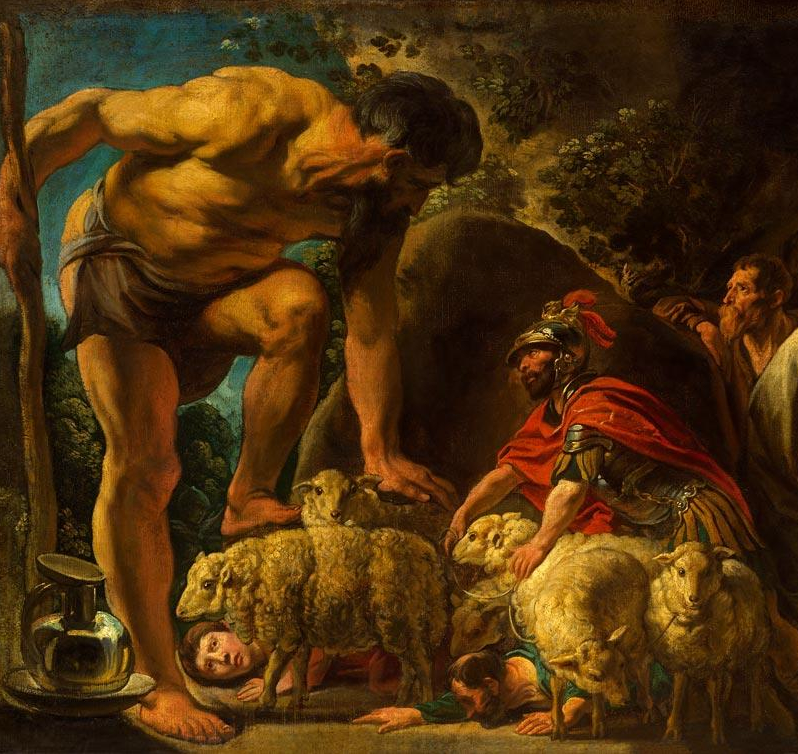 Odysseus in the Cave of Polyphemus / Jacob Jordaens